

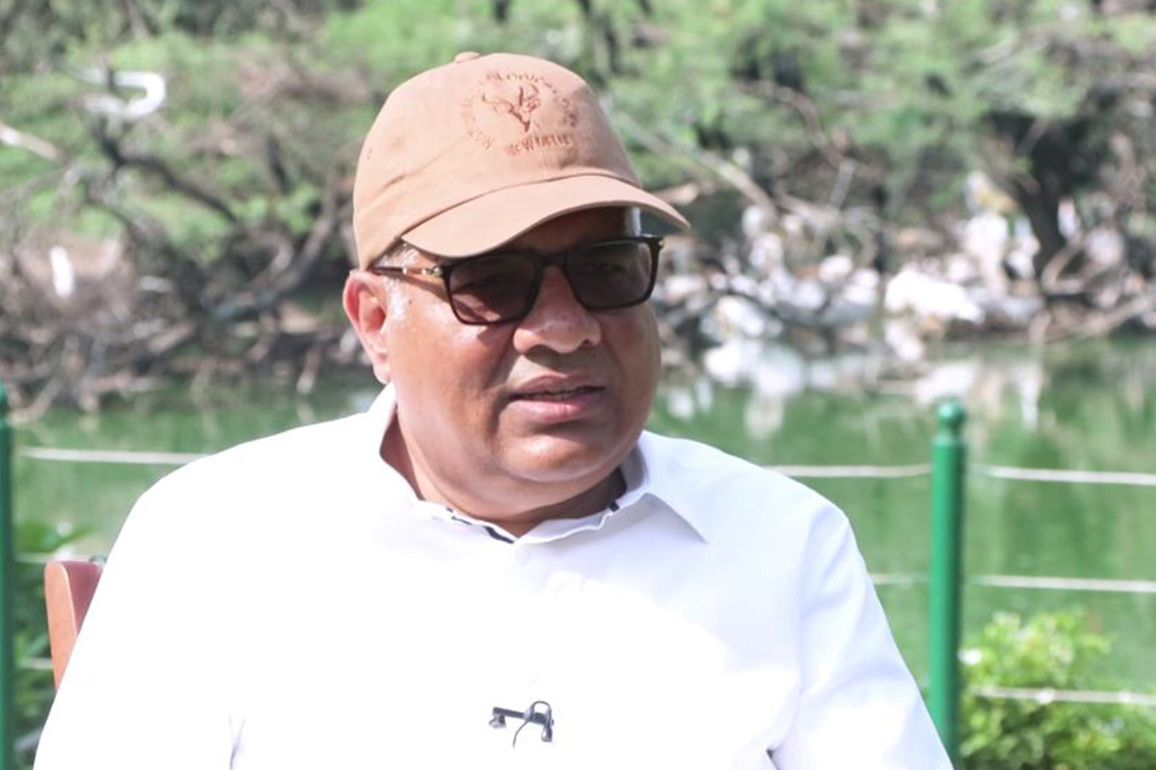
New Delhi [India], June 5 (ANI): On World Environment Day, Union Minister of Environment, Forest and Climate Change Bhupender Yadav outlined a massive 12-year environmental conservation roadmap implemented by the central government.
Speaking in an exclusive interview with ANI, Yadav detailed a sweep of policy changes, species protection programs, and severe crackdowns on pollution aimed at accelerating India's sustainable development.
A primary highlight of the briefing was India's monumental expansion of protected wetlands. Since 2014, the central government has expanded the number of globally recognised Ramsar sites from a mere 24 to a historic milestone of 100 lakes.
The number of dedicated tiger reserves across the country has scaled up significantly, rising from 48 to 58.
'After Prime Minister Narendra Modi arrived in 2014, we declared Ramsar sites to promote the conservation of our lakes. At that time, they were 24 in number. Today, on World Environment Day, we have increased it, and 100 lakes of India have been declared as Ramsar sites in recent years,' he said.
Only 24 ESZs and protected forest areas were officially notified before 2014. Today, that number has skyrocketed to approximately 380 under the current administration's aggressive protective oversight.
Speaking on Eco-Sensitive Zones and protected forest areas, Yadav added, 'Protected forest areas, and especially the ESZs (Eco-Sensitive Zones), only 24 were notified until 2014. Today, we have brought that number to around 380. We have done the same to increase the number of protected areas as well.'
He further added that the government implemented special programs like Project Lion, Project Tiger, Project Cheetah, Project Gharial, and Project Great Indian Bustard, to pull endangered species back from the brink.
Amending the landmark Biodiversity Act has paved the way for the creation of a localised biodiversity register in every single Indian village, aimed directly at guarding native flora and fauna.
'For biodiversity conservation in the country, we also brought changes to the Biodiversity Act, and we are working towards creating a biodiversity register in every single village so that native species can be protected,' he said.
To combat aggressive coastal erosion, the centre rolled out the 'MISHTI' Mangrove project. Concurrently, the Aravalli conservation program has been mobilised to shield India's ancient mountain systems.
'Along with that, for the threat of coastal erosion and damage to the coastline around our marine areas, we started Project Mangrove under the name of 'MISHTI'. And for the protection of ancient mountain ranges like the Aravallis, we have also started the Aravalli conservation program,' Bhupendra Yadav added.
Addressing the demands of rapid urban growth, Minister Yadav placed heavy emphasis on the transition to a circular economy. The government has introduced robust new rules governing the recycling and management of waste rubber, plastics, used oil, and critical minerals. This structural shift runs alongside massive upgrades to India's solar power grids and non-fossil fuel capacities.
'On the other hand, due to environmental activities, we facilitated rules to build a circular economy for sustainable development, whether it concerns waste rubber, plastic, the issue of used oil, or the issue of critical minerals. Today, energy emission is also necessary, so whether it is increasing India's solar capacity, increasing capacities from non-fossil fuels, or granting permissions to industries while keeping environmental standards in mind, we have worked to take this forward,' he said.
To bridge the gap between policy and daily citizen action, Yadav championed the Prime Minister's signature 'Mission LiFE' initiative, which targets urban centres through seven core pillars: saving water, food, energy, a total ban on single-use plastics, robust solid waste management, adopting a healthy lifestyle and cultivating a circular economy.
'And most of all, since all of us do not live in forests or rural areas but in urban areas, we have run an initiative under the leadership of the Prime Minister in the form of 'Mission LiFE'. We are working to take forward the seven dimensions of Mission LiFE: Save Water, Save Food, Save Energy, Ban Single-Use Plastic, Solid Waste Management, Healthy Lifestyle, and the most significant issue, Circular Economy,' he said.
Additionally, to foster community-led afforestation, the country is actively driving the 'Ek Ped Maa Ke Naam' campaign, urging citizens nationwide to plant trees as a personal commitment to environmental healing. (ANI)